
Key Person Insurance (Key Man Insurance), Explained in Plain English
Written by Kelly Raulerson · Last updated FacebookEmail
Not sure how much coverage you need? Our free calculator adds it up in about 2 minutes. It doesn’t ask for your name, email, or phone.
What is key person insurance?
Key person insurance is life insurance that protects a business from losing one person. Not the family. The business.
A “key person” is anyone whose death would cost the business real money. Think about who brings in the biggest clients, who holds the recipes or the code in their head, or whose name is on the bank loan. In a small business, that’s often the owner.
Key man insurance, key employee insurance, and key person life insurance all mean the same thing. “Key person” is the newer term, and it’s what most insurers use now.
How key person insurance works
- 1
The business applies. The business picks the person to insure and the coverage amount. The insurer looks at that person’s age and health, and at the business’s finances, to decide how much coverage makes sense.
- 2
The person says yes, in writing. Before the policy is issued, the person being insured gets written notice and signs a consent form. This step matters for taxes later, so don’t skip it.
- 3
The business pays the premiums. The premiums come out of the business, not the person’s paycheck.
- 4
If the person dies, the business gets the money. The business is the beneficiary, and it can use the payout however it needs to.
Here’s who’s who on a key person policy:
| Role | Who it is |
|---|---|
| Owner of the policy | The business |
| Pays the premiums | The business |
| Insured person | The key person |
| Beneficiary | The business |
Compare that with a personal life insurance policy, where you own the policy and your family is the beneficiary.
What can the business do with the money? Anything it needs to stay afloat. Common uses include:
- ✓Covering lost revenue while sales recover
- ✓Paying off loans or lines of credit
- ✓Recruiting, hiring, and training a replacement
- ✓Reassuring lenders, customers, and vendors that the business will keep going
- ✓Giving partners cash to buy the owner’s share from the family
- ✓Closing the business in an orderly way, if that’s the plan
Who needs key person insurance (and who doesn't)
Ask yourself one question: if this person died tomorrow, would the business lose money it couldn’t absorb? If the answer is yes, key person coverage is worth a look.
It usually makes the most sense when a business has:
- ✓Partners or co-owners who would need cash to keep going or to buy out a family
- ✓Employees whose jobs depend on the business surviving
- ✓Loans or lines of credit, especially ones tied to the owner. Some lenders require life insurance on the owner before they’ll approve a business loan.
- ✓One rainmaker who brings in most of the revenue or holds the key client relationships
- ✓Specialized know-how that would take months and real money to replace
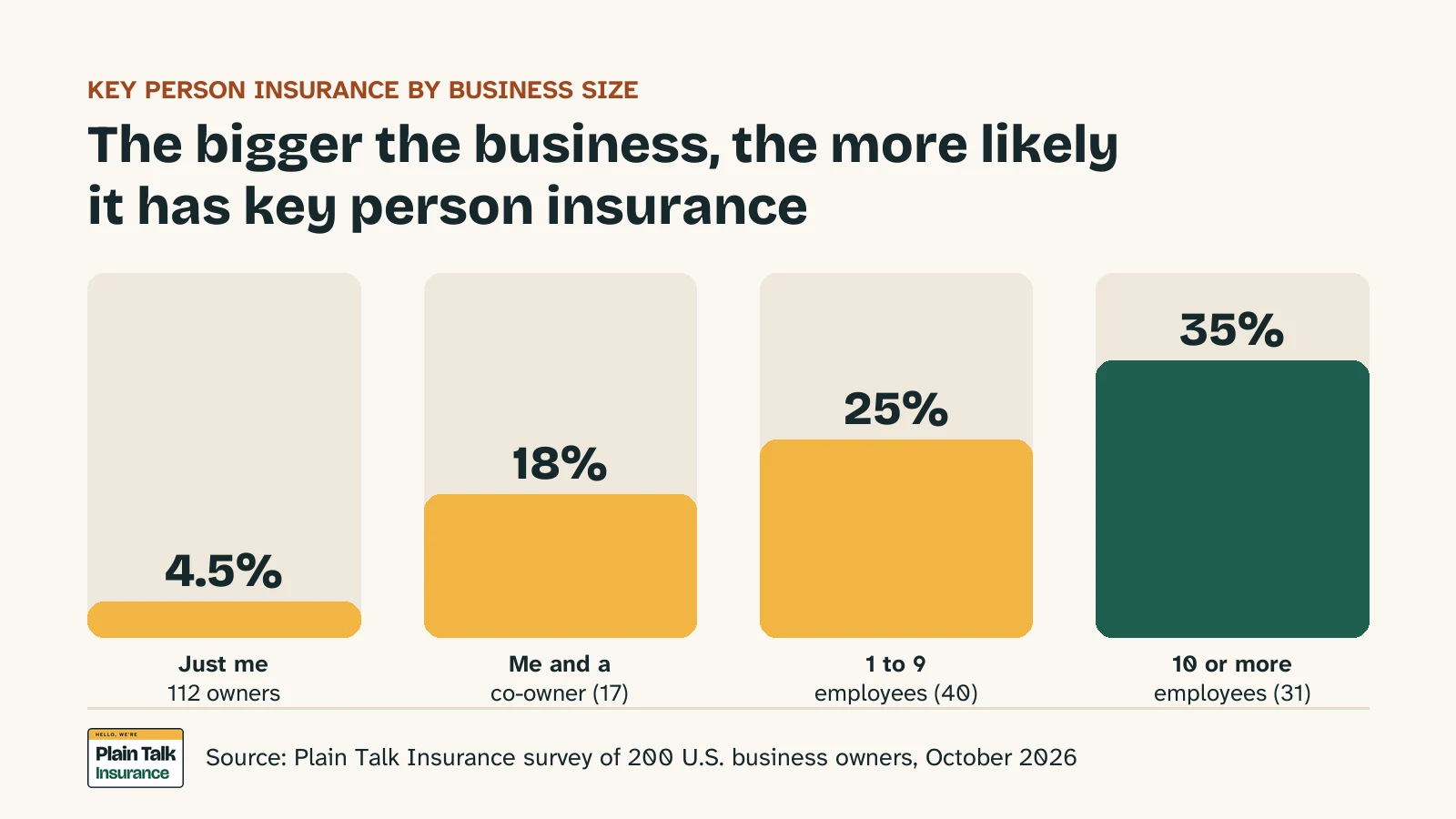
Most businesses don’t have it. In our October 2026 survey of 200 business owners, only 14.5% had key person insurance. Coverage climbed with the size of the business, but even among owners with 10 or more employees, most went without:
| Who works in the business | Have key person insurance | Owners surveyed |
|---|---|---|
| Just me | 4.5% | 112 |
| Me and a co-owner | 18% | 17 |
| Me and 1 to 9 employees | 25% | 40 |
| Me and 10 or more employees | 35% | 31 |
The co-owner and employee groups are small, so read those numbers as a direction rather than an exact measure.
What if you work alone?
This is where most guides get fuzzy, so here’s the plain version.
If you’re a sole proprietor, you and the business are the same thing in the eyes of the law and the IRS. When you die, the business generally ends and its assets and debts become part of your estate. A policy “owned by the business” is really owned by you. For most sole proprietors, a personal life insurance policy that pays your family does the job better.
If you run a single-member LLC or an S corp by yourself, the business can own a policy on you. But ask what the money would actually do. If the business would close without you, there may be nothing left to protect. A personal policy big enough to cover your family and any business debt you personally guaranteed often fits better. In our survey, 1 in 5 owners had a business loan or debt they personally guaranteed.
Key person coverage starts to earn its keep for solo owners when something would outlive you: a buyer waiting in the wings, a contract that has to be finished, or a lender who wants the loan covered.
See the full results: We asked 200 business owners what happens if they die tomorrow.
How much key person insurance do you need?
There’s no single formula. Insurers and planners use a few common methods, and it helps to run more than one.
- 1
A multiple of pay. Nationwide suggests starting at 5 to 7 times the key person’s salary.
- 2
Pay plus profit. Guardian suggests adding the person’s salary to what they directly bring to the bottom line, then multiplying by at least 5.
- 3
Replacement cost. Add up what it would take to replace them: recruiting, a signing bonus, training, and the sales you’d lose while the new person gets up to speed.
- 4
Debt. Total up any loans or credit lines tied to the person. If a lender requires life insurance as collateral, the policy needs to be at least that big.
A worked example
Say a two-owner design studio wants to insure one co-owner. She earns $120,000 a year, the clients she personally brings in add about $200,000 a year in profit, and the studio has a $250,000 line of credit.
| Method | The math | Result |
|---|---|---|
| Multiple of pay | $120,000 x 5 to 7 | $600,000 to $840,000 |
| Pay plus profit | ($120,000 + $200,000) x 5 | $1,600,000 |
| Replacement cost | Recruiting and training ($40,000) + a year of lost profit ($200,000) | $240,000 |
| Debt | Balance on the line of credit | $250,000 |
The answers range from $240,000 to $1.6 million. That spread is normal. The low numbers show the bare minimum to keep the doors open. The high numbers reflect what she’s actually worth to the business.
Insurers also set limits. They’ll look at the business’s revenue, profit, and the person’s pay, and they generally won’t approve more coverage than the finances can justify.
Keep in mind that this policy only protects the business. If the same person also needs to protect a family, our life insurance calculator can help figure out the personal side.
What does key person insurance cost?
Key person insurance is priced like any other life insurance policy on the same person. The business is the buyer, but the insurer is pricing the risk of that one person dying. The price depends on:
- ✓Age. The younger the key person, the lower the premium.
- ✓Health and tobacco use. The insurer will usually ask health questions and may require an exam.
- ✓Coverage amount. More coverage costs more.
- ✓Term or permanent. Term coverage costs far less than permanent coverage for the same payout.
- ✓Term length. A 20-year term costs more than a 10-year term.
For a large policy, expect the insurer to ask for business financials too, like tax returns or a profit and loss statement, to back up the amount.
One more thing about cost. “Too expensive” was the top reason owners in our survey gave for skipping life insurance (37%). But people tend to guess high. In the 2025 Insurance Barometer Study from LIMRA and Life Happens, healthy adults ages 18 to 30 guessed the median cost of a $250,000, 20-year term policy at about 10 to 12 times what it actually costs. Get a real quote before you rule it out.
Term or permanent for key person coverage
Many key person policies are term life insurance, because most business needs have an end date. Permanent coverage, like whole life insurance, can make sense when the need lasts as long as the person does.
| Term | Permanent | |
|---|---|---|
| How long it lasts | A set number of years, like 10, 20, or 30 | For life, as long as premiums are paid |
| Cost | Lower | Much higher for the same payout |
| Cash value | Usually none | Builds cash value the business can borrow against |
| Good fit for | A loan, a buyout timeline, the years until a successor is ready | Long-term buy-sell funding, an executive the business plans to keep for decades |
Many term policies can be converted to permanent coverage later without a new medical exam. That can be a useful middle path. For more, see term vs whole life insurance.
Our free calculator adds it up in about 2 minutes. It doesn’t ask for your name, email, or phone.
Key person insurance taxes: the part most guides skip
Most key person guides stop at “premiums aren’t deductible and the payout is tax-free.” That’s only half the story. The payout is tax-free only if the business follows a specific set of IRS rules before the policy is issued.
Are the premiums tax-deductible?
Generally, no. Federal tax law doesn’t allow a deduction for life insurance premiums when the business paying them is also a beneficiary of the policy. That’s the whole setup of key person insurance, so the premiums come out of after-tax dollars.
Is the payout taxable?
It’s generally tax-free, as long as the business did two things right:
- 1
It met the notice and consent rules before the policy was issued.
- 2
The insured person fits one of the IRS exceptions. The most common ones: the person was an employee at some point in the 12 months before they died, or, when the policy was issued, they were a director, a highly compensated employee, or among the highest-paid 35% of employees. An owner with more than 5% of the business counts as highly compensated. There’s also an exception when the money goes to the person’s family or is used to buy their ownership share from the family.
Miss the notice and consent step, and the tax-free part of the payout is capped at the total premiums the business paid. The rest can be taxable income.
Here’s what that looks like. A business buys a $1 million policy on its sales director and pays $30,000 in premiums over the years, but nobody signed the consent form. If she dies, only $30,000 is tax-free. The other $970,000 may be taxed as income.
The notice and consent checklist
These rules apply to life insurance a business owns on an employee, which generally includes owners who work in the business. Before the policy is issued, the person being insured must:
- ✓Be told in writing that the business intends to insure their life, and the maximum amount of coverage
- ✓Give written consent to being insured, including consent that the coverage may continue after they leave the business
- ✓Be told in writing that the business will be a beneficiary of the payout
Keep signed copies with the policy. Many insurers include a notice and consent form in their application, but it’s the business’s job to make sure it’s done, dated, and filed before the policy is issued.
File Form 8925 every year
A business that owns life insurance on employees, for policies issued after August 17, 2006, reports it to the IRS each year on Form 8925. The form asks how many employees are covered, the total coverage in force at year end, and whether the business has valid consent for each of them.
Tax rules depend on how your business is set up, so have a tax professional review any key person policy before it’s issued, not after.
Key person disability insurance
A key person doesn’t have to die for the business to take a hit. A serious illness or injury can sideline them for months.
Key person disability insurance pays the business if the insured person can’t work because of an illness or injury. Depending on the policy, it pays a monthly benefit or a lump sum, usually after a waiting period. The business owns it, pays for it, and receives the benefit, just like key person life insurance.
Don’t mix it up with these two:
- ✓Business overhead expense insurance pays the business’s fixed bills, like rent, utilities, and staff wages, while the owner is disabled.
- ✓Personal disability insurance replaces your own paycheck and pays you, not the business.
What happens if the key person leaves?
People quit, retire, and sell their share. The policy doesn’t vanish when they do. The business has a few options:
- 1
Keep it. The consent form covers coverage continuing after the person leaves. Whether a future payout stays tax-free depends on the person’s status when the policy was issued, so check with a tax professional.
- 2
Cancel it. For a term policy, the business stops paying and the coverage ends. A permanent policy may pay out its cash value when surrendered, and part of that can be taxable.
- 3
Transfer it to the person. Some businesses hand or sell the policy to the departing key person, who can then name their own family as beneficiary. Transfers to the insured person avoid a tax trap that applies to most policy sales, but the value of the policy may count as taxable income to them.
One thing key person insurance can’t do: it can’t protect the business from someone quitting to join a competitor. It only pays for death, or disability if you have that coverage.
Key person insurance vs. buy-sell vs. personal life insurance
These three get confused all the time. They do different jobs.
| Key person insurance | Buy-sell funded with life insurance | Personal life insurance | |
|---|---|---|---|
| Who owns the policy | The business | The business or the other owners | You |
| Who gets the money | The business | The business or the other owners, who use it to buy the share from the family | Your family or whoever you name |
| What it protects | The business’s income, debts, and stability | A smooth handoff of ownership | Your household |
| Needs a written agreement | No, but notice and consent are required | Yes, a buy-sell agreement drawn up by an attorney | No |
Many owners need more than one. A co-owner might have key person coverage so the business survives, a buy-sell agreement so the family gets paid fairly, and a personal policy for the household.
Pros and cons of key person insurance
Pros
- ✓Gives the business cash at the exact moment it’s most likely to run short
- ✓The payout is generally tax-free when the rules are followed
- ✓Can satisfy a lender’s life insurance requirement
- ✓Buys time to hire, sell, or close down in an orderly way
- ✓Term coverage is usually affordable for a healthy, younger key person
Cons
- ✓Premiums generally aren’t tax-deductible
- ✓Doesn’t pay the key person’s family
- ✓Paperwork mistakes, like a missing consent form, can make most of the payout taxable
- ✓Can’t protect against someone quitting
- ✓Permanent coverage can get expensive, and a policy that’s too small may not solve much
How to set up key person insurance
- 1
Name your key people. List anyone whose death would cost the business real money, owners included.
- 2
Pick a coverage amount. Run two or three of the methods above and settle on a number the business’s finances can support.
- 3
Choose term or permanent. Match the length of the coverage to the length of the need.
- 4
Get notice and consent signed first. Written notice and written consent, before the policy is issued. Keep copies with your business records.
- 5
Apply. Expect health questions, possibly an exam, and a request for business financials on larger policies.
- 6
Keep up with it. File Form 8925 with the business’s tax return each year, and review the coverage every year or two, or whenever the business, its debts, or its people change.
A licensed insurance professional can compare policies from several insurers. A tax professional and an attorney can handle the tax and buy-sell side.
Our free calculator adds it up in about 2 minutes. It doesn’t ask for your name, email, or phone.
Frequently asked questions
Is key man insurance worth it?
It's worth considering when a business would lose money it couldn't absorb if one person died, especially when there are partners, employees, or loans that depend on that person. A solo owner with no debt and no staff often gets more value from a personal life insurance policy that pays their family.
Who owns a key man insurance policy?
The business does. The business applies for the policy, pays the premiums, and is named as the beneficiary. The person being insured has to get written notice and give written consent before the policy is issued.
Who is eligible for key man insurance?
Any person whose death would cause the business a financial loss, such as an owner, partner, executive, top salesperson, or someone with hard-to-replace skills. The insurer has to agree that the business has a real financial interest in that person's life, and the person has to consent.
Is key person insurance tax deductible?
Generally, no. Federal tax law doesn't allow a business to deduct life insurance premiums when the business is a beneficiary of the policy.
Is key person insurance taxable?
The payout is generally tax-free to the business if the notice and consent rules were met before the policy was issued and the insured person fits one of the IRS exceptions, such as being an employee within 12 months of death or a highly compensated employee when the policy was issued. If those rules aren't met, only the amount of premiums paid is tax-free, and the rest can be taxable income.
How much does key person insurance cost?
It costs about the same as an individual life insurance policy on the same person. The price depends on the person's age, health, and tobacco use, the coverage amount, and whether the policy is term or permanent. Term coverage costs much less than permanent coverage.
What are the disadvantages of key man insurance?
The premiums generally aren't tax-deductible, the policy doesn't pay the insured person's family, and a missed consent form can make most of the payout taxable. It also can't protect a business from a key person quitting.
Can a sole proprietor get key person insurance?
A sole proprietor can buy life insurance, but because the owner and the business are legally the same, a "business-owned" policy is really a personal one. Most sole proprietors are better served by a personal policy that pays their family and covers any business debt they owe.
What is key person disability insurance?
Key person disability insurance pays the business if a key person can't work because of an illness or injury. It's different from personal disability insurance, which pays you, and business overhead expense insurance, which pays the business's fixed bills while the owner is disabled.
What happens to key person insurance when an employee leaves?
The business can keep the policy, cancel it, or transfer it to the departing person. Each choice has different tax effects, so talk with a tax professional first.
Can a business insure more than one key person?
Yes. A business can buy a separate policy on each person it depends on, as long as each one gives written consent and the business can justify the coverage amounts.
Is key man insurance the same as life insurance?
Key man insurance is a type of life insurance. The difference is who owns it and who gets paid. With key man insurance, the business owns the policy and receives the payout. With personal life insurance, you own it and your family receives the payout.
Share this guide
Know someone sorting this out? Send it their way, or print a copy to keep.
- Plain Talk Insurance survey of 200 U.S. business owners, fielded October 13, 2026, through Pollfish
- 26 U.S. Code Section 101, Certain death benefits, including subsection (j) on employer-owned life insurance
- 26 U.S. Code Section 264, Certain amounts paid in connection with insurance contracts
- IRS, About Form 8925, Report of Employer-Owned Life Insurance Contracts
- Guardian, A Guide to Key Person Life Insurance
- Nationwide, What is key person insurance
- LIMRA and Life Happens, 2025 Insurance Barometer Study
Please read
This page is for general education only. It is not an offer of insurance or advice about insurance, taxes, law, or your finances.
Plain Talk Insurance is not a licensed insurance agency and does not sell, solicit, or negotiate insurance. Nothing here recommends a specific policy, plan, or insurer.
Tax rules can change and depend on how your business is set up. Talk with a licensed insurance professional, an attorney, and a tax professional about your own situation.
Share this guide
Know someone sorting this out? Send it their way, or print a copy to keep.

Kelly Raulerson is the founder of Plain Talk Insurance. She has spent more than a decade turning complicated topics into plain English, including building a website that reached a million readers a year. She lives in the Portland area and is completing her Oregon life and health insurance license.