
We Asked 200 Business Owners What Happens If They Die Tomorrow. The Answers Are Bleak.
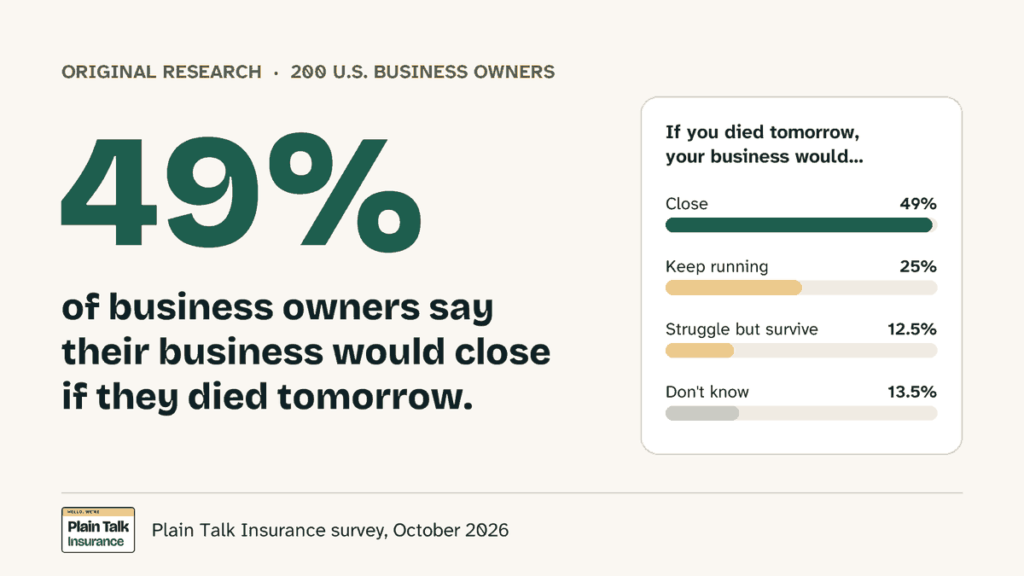
The short answer: In an October 2026 Plain Talk Insurance survey of 200 U.S. business owners who have been in business at least two years, 49% said their business would close if they died tomorrow, and 49% had no life insurance at all. Only 14.5% had key person insurance, 19.5% didn’t know what it is, and 74% had no written succession plan. Solo owners were nearly twice as likely as owners with employees to have no life insurance (58% vs. 30%).
Key findings
- 49% of business owners say their business would close if they died tomorrow.
- 49% have no life insurance of any kind.
- 44% have no life insurance, no key person insurance, and no written succession plan. None of the three.
- Only 14.5% have key person insurance. 1 in 5 don’t know what it is.
- 74% have no written plan for what happens to the business when they die.
- 58% of solo owners have no life insurance, compared with 30% of owners with employees.
- “Too expensive” is the top reason owners give for skipping life insurance (37%).
Writers and researchers: you’re welcome to use these numbers. Please cite Plain Talk Insurance and link to this page.
We asked 200 business owners a question most of us would rather skip: if you died tomorrow, what happens to the thing you built?
The answers were sobering. Half of the owners we surveyed said their business would simply close. And half of all the owners we asked had no life insurance to soften the landing for the people they’d leave behind.
None of this means business owners are careless. Most owners are busy keeping the lights on, and planning for their own absence keeps sliding to next quarter. Here’s what 200 owners told us, and what the numbers mean for anyone who works for themselves.
Half say their business would close if they died tomorrow
We asked owners one blunt question: If you died tomorrow, what would happen to your business?
| What would happen | Share of owners |
|---|---|
| It would close | 49% |
| It would keep running without me | 25% |
| It would struggle but survive | 12.5% |
| I honestly don’t know | 13.5% |
Only 1 in 4 owners believe the business would keep running without them. Put “it would close” and “I don’t know” together, and more than 6 in 10 owners (62.5%) have no confidence the business would outlive them.
The owners who expect their business to close are also the least prepared for it:
- 58% of them have no life insurance.
- 89% of them have no written succession plan.
That’s the gap in one picture. The owners whose businesses depend most on them personally are the ones with the least protection if something happens to them.
Half of business owners have no life insurance
Nearly half of the owners we surveyed (49%) have no life insurance of any kind.
| Do you have life insurance? | Share of owners |
|---|---|
| Yes, a policy I pay for myself | 40% |
| Yes, a policy my business pays for | 6.5% |
| Only through a job or my spouse’s job | 3.5% |
| No | 48.5% |
| Not sure | 1.5% |
Here’s the part that surprised me. Overall, owners have life insurance at about the same rate as everyone else. Half of the owners in our survey have some coverage, and the 2025 Insurance Barometer Study from LIMRA and Life Happens puts all U.S. adults at 51%.
The difference is where the coverage comes from. That same study found that 55% of working adults have life insurance through their employer. Business owners are the employer. Only 3.5% of the owners we surveyed get coverage through a job or a spouse’s job. If an owner has life insurance, they almost always had to go out and buy it themselves.
Many of the insured are underinsured
We asked the 93 owners with their own policy how much coverage they carry.
| Coverage amount | Share of insured owners |
|---|---|
| Under $100,000 | 25.8% |
| $100,000 to $250,000 | 30.1% |
| $250,000 to $500,000 | 22.6% |
| $500,000 to $1 million | 15.1% |
| Over $1 million | 3.2% |
| I don’t know | 3.2% |
More than half (56%) carry less than $250,000. One in four carry less than $100,000. Whether that’s enough depends on the person, but it has to cover a household and, for many owners, business debts too.
How much life insurance do you need?
The top reasons owners skip life insurance
We asked the 97 owners with no life insurance for their main reason.
| Main reason | Share of uninsured owners |
|---|---|
| Too expensive | 37.1% |
| Don’t think I need it | 25.8% |
| Haven’t gotten to it | 23.7% |
| Don’t know where to start | 10.3% |
| Don’t trust it | 3.1% |
Cost leads the list, which matches national research. LIMRA and Life Happens also found that “too expensive” is one of the top two reasons Americans give for not buying life insurance.
Cost may also be the most misunderstood reason. In the 2025 Insurance Barometer Study, healthy adults ages 18 to 30 guessed the median cost of a $250,000, 20-year term policy at about 10 to 12 times what it actually costs.
The next two answers are worth a closer look:
- “Don’t think I need it” (26%). Some owners may be right, such as those with no dependents and no business debt. Still, of the 25 owners who gave this answer, 17 also said their business would close without them.
- “Haven’t gotten to it” (24%). Add “don’t know where to start” (10%), and about a third of uninsured owners aren’t saying no. They’re saying not yet.
That’s a very human answer. When you run your own business, the urgent stuff always wins. Planning for the day you’re not there never feels urgent, right up until it is.
Only 1 in 7 have key person insurance, and 1 in 5 have never heard of it
Key person insurance (also called key man insurance) is a life insurance policy a business buys on an owner or another person the business can’t easily replace. The business pays the premiums and receives the payout. That money can cover lost income, pay off debt, fund a search for a replacement, or help partners buy out the owner’s share.
Here’s how many owners have it:
| Does your business have key person insurance? | Share of owners |
|---|---|
| Yes | 14.5% |
| No | 66% |
| I don’t know what that is | 19.5% |
One in five owners didn’t recognize the term, even with “key man insurance” spelled out in the question.
Coverage climbs with the size of the business:
| Who works in the business | Have key person insurance | Owners surveyed |
|---|---|---|
| Just me | 4.5% | 112 |
| Me and a co-owner | 18% | 17 |
| Me and 1 to 9 employees | 25% | 40 |
| Me and 10 or more employees | 35% | 31 |
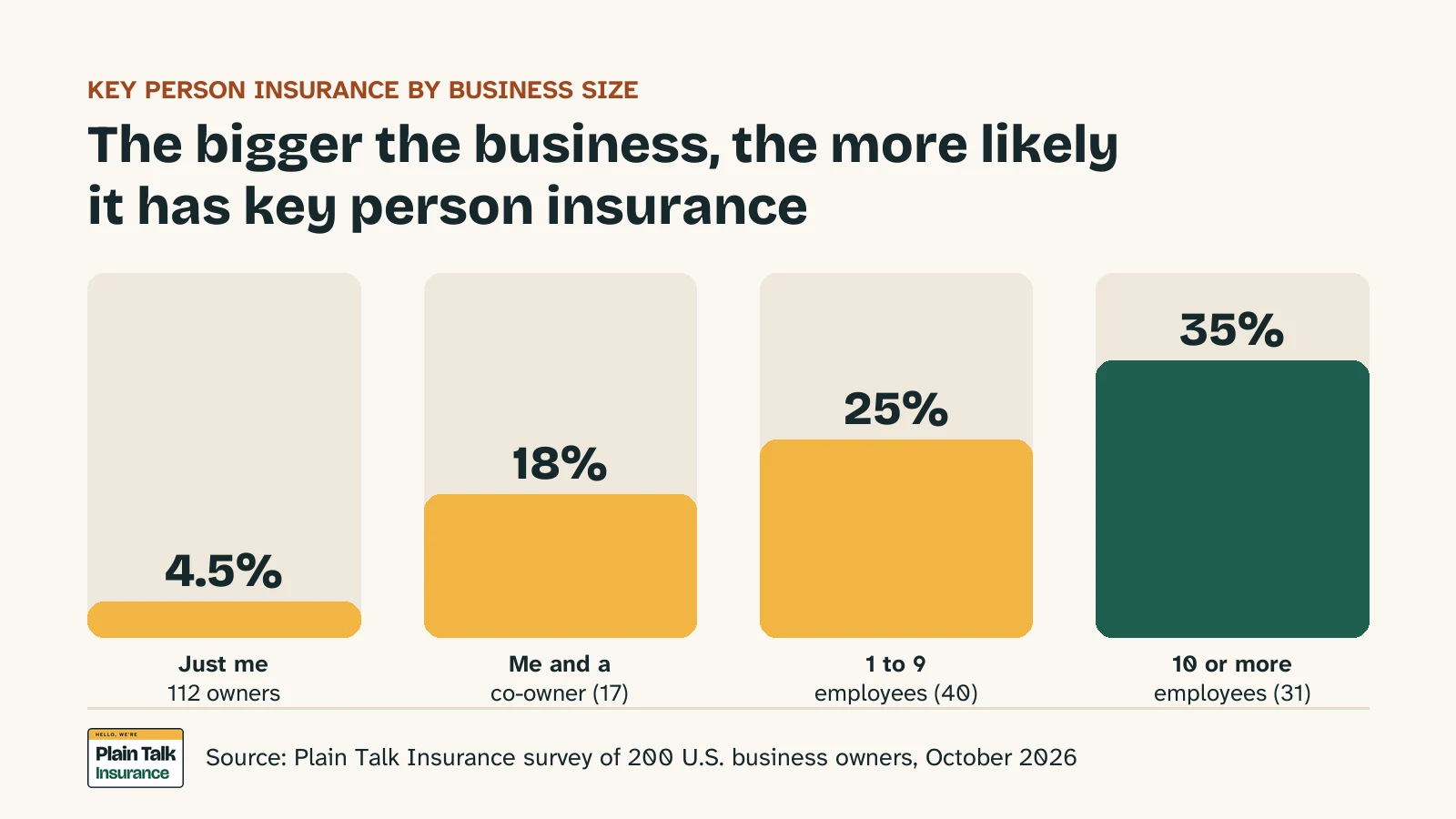
The co-owner and employee groups are small, so read those numbers as a direction, not a precise measure. The pattern is still clear: even among owners with 10 or more employees, most don’t have it.
Three in four have no written succession plan
A succession plan spells out what happens to a business when the owner dies or can’t work: who takes over, who buys whom out, and where the money comes from.
| Do you have a written succession plan? | Share of owners |
|---|---|
| Yes, in writing | 26% |
| We’ve talked about it, but nothing is written | 27% |
| No | 47% |
Only about 1 in 4 owners have a plan in writing. Another 27% have talked about it, which is a start, but a conversation isn’t a document anyone can act on.
Co-owners: the buy-sell agreement
If you have a business partner, a buy-sell agreement is the part of the plan that matters most. It’s a contract that says what happens to an owner’s share if they die or leave, usually that the remaining owners buy it at an agreed price. Life insurance is a common way to fund it, so the surviving owners have cash to pay the family.
Of the 17 owners in our survey who run their business with a co-owner, 15 had no written succession plan.
44% have none of the three
When we put the three questions together, 44% of owners said no to all of them:
- No life insurance
- No key person insurance
- No written succession plan
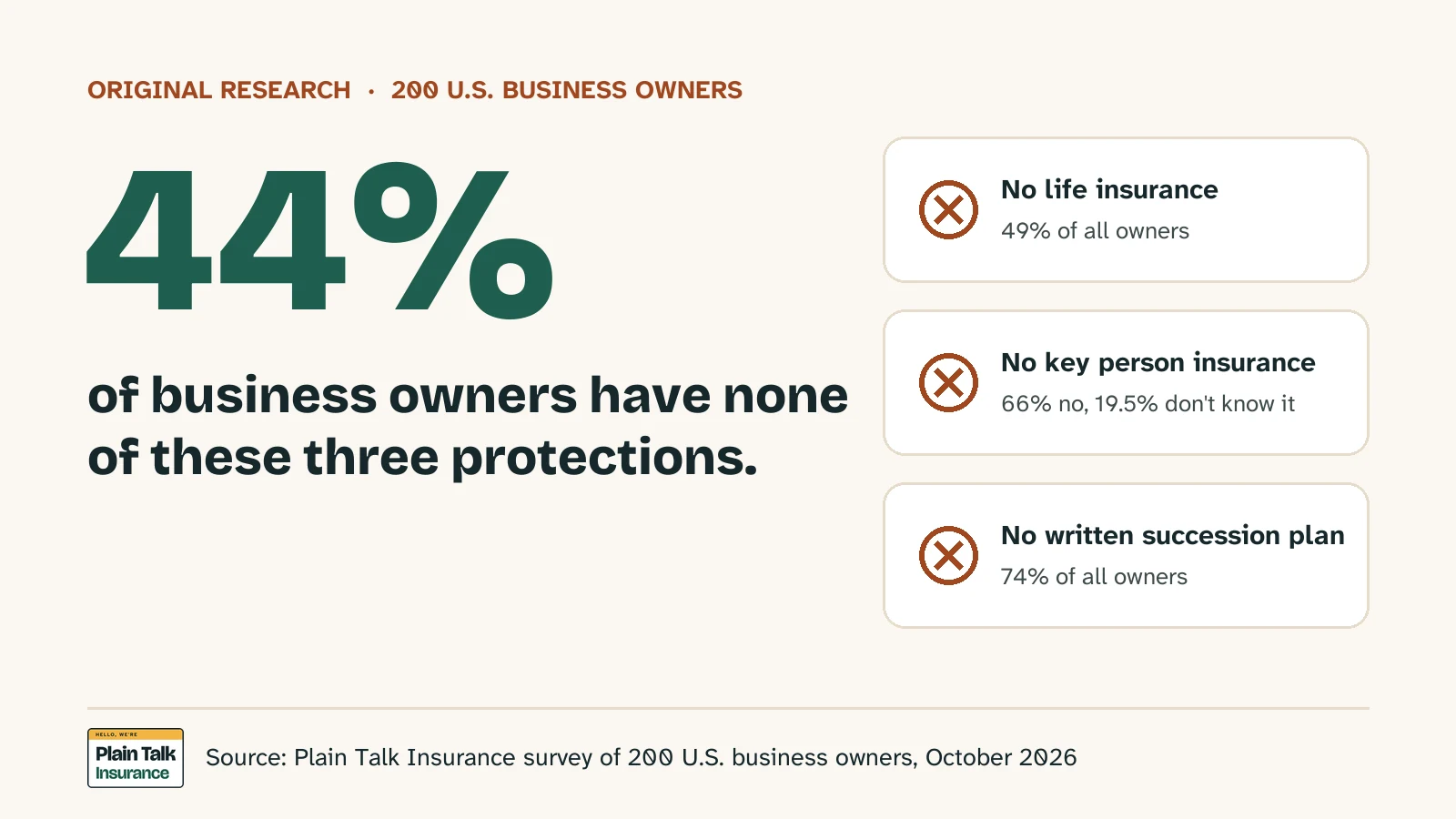
For nearly half of the owners we surveyed, none of these three protections is in place for the business or the family if the owner dies tomorrow.
Solo owners are nearly twice as likely to have no life insurance
More than half of the owners we surveyed (56%) run their business alone. They’re the most exposed group in every way we measured.
| Solo owners | Owners with employees | |
|---|---|---|
| No life insurance | 58% | 30% |
| Business would close if they died | 71% | 20% |
| No written succession plan | 83% | 56% |
| Have key person insurance | 4.5% | 30% |
| Owners surveyed | 112 | 71 |
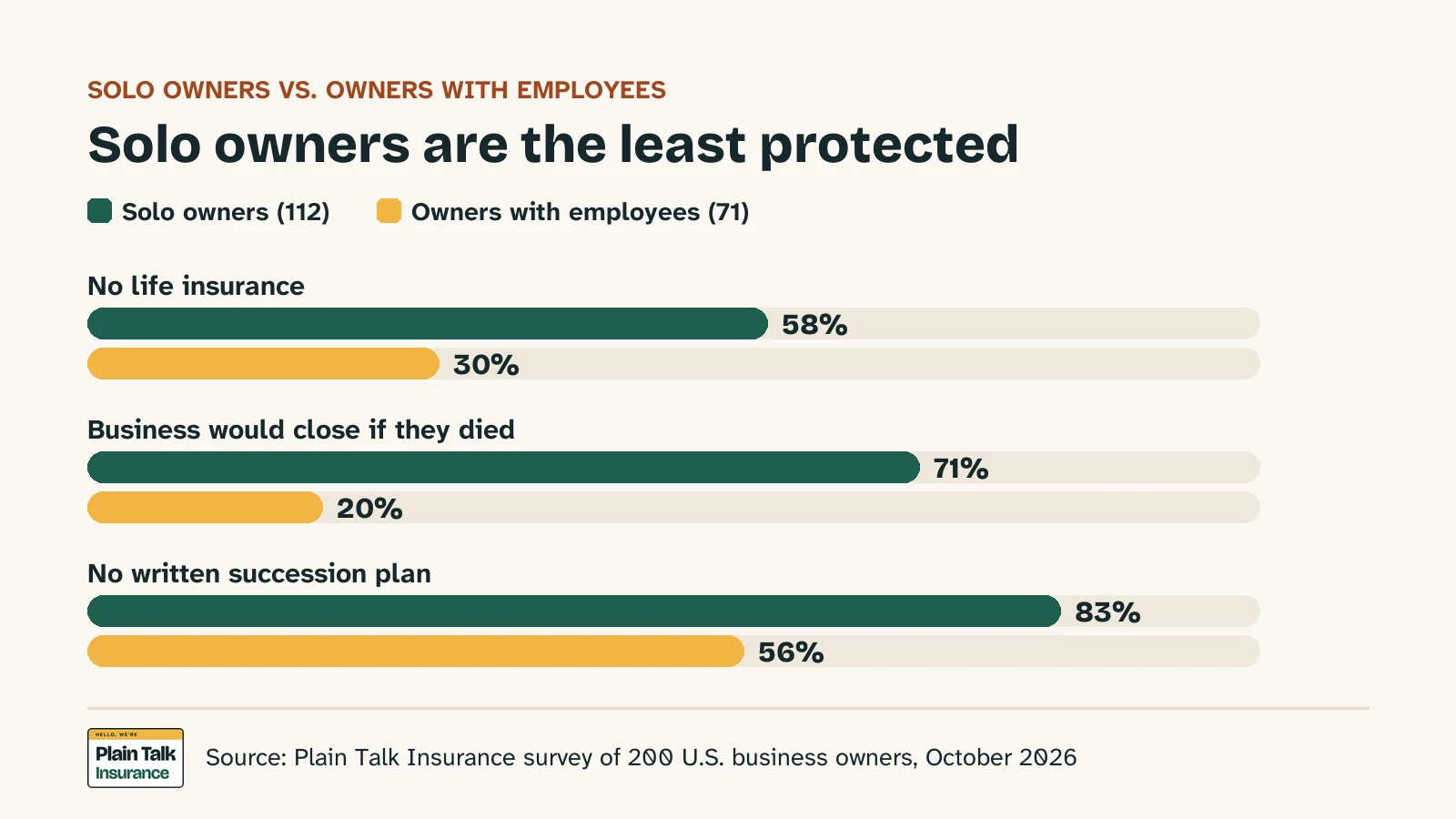
Owners with employees includes those with 1 to 9 employees and those with 10 or more. Owners with a co-owner and no employees (17) are not in either column.
It makes sense. When you’re a team of one, there’s no HR department handing you a benefits packet, and nobody enrolls you in anything. If you want life insurance, disability coverage, or a plan for the business, you have to find it, figure it out, and pay for it yourself, usually after a full day of doing everything else.
How business owners get health insurance
Life insurance isn’t the only coverage owners have to piece together. We also asked how they get health insurance.
| How do you get health insurance right now? | Share of owners |
|---|---|
| I buy my own plan | 35.5% |
| Medicaid or a state plan | 27% |
| Medicare | 11.5% |
| I don’t have any | 10% |
| Through my spouse or partner’s job | 9% |
| Through a group plan at my own company | 4.5% |
| Something else (VA, military, or other) | 1.5% |
| Through another job I work | 1% |
A few things stand out:
- 1 in 10 owners have no health insurance at all.
- More than 1 in 4 rely on Medicaid or a state plan.
- Only 4.5% get coverage through a group plan at their own company. Even among owners with employees, just 7 of 71 (about 10%) get their own coverage that way. Nearly half of them (48%) buy their own plan instead.
For most owners, health insurance is a do-it-yourself project, just like life insurance. Our guide to self-employed health insurance in Oregon walks through the options.
Self-employed and buying your own health insurance?
Term or permanent, and can the business pay?
Most coverage questions from owners come down to two things: what kind of policy, and whose name is on it.
Term or permanent life insurance for business owners
Term life insurance covers you for a set number of years, such as 10, 20, or 30. It tends to fit needs with an end date: a business loan, kids still at home, or a buy-sell agreement with a known timeline.
Permanent life insurance, such as whole life, lasts your whole life and builds cash value. It costs more for the same death benefit and is usually used for lifelong needs like estate planning. For a side-by-side look, see term vs whole life insurance.
Can the business pay for it?
Yes, a business can pay for life insurance on its owner. What changes is who owns the policy, who gets the money, and how it’s taxed.
- Personal coverage paid by the business. The policy protects your family. Depending on how it’s set up, the premiums may count as taxable income to you.
- Key person coverage. The business owns the policy and receives the payout. The premiums generally aren’t tax-deductible.
- Notice and consent. When a business buys a policy on an employee, which can include an owner on the payroll, the employee must get written notice and give written consent before the policy is issued (IRS Form 8925). Skipping that step can make part of the payout taxable.
Talk with a tax professional before setting up either kind.
What business owners can do this month
You don’t have to fix all of this in a weekend. Here are five steps, roughly in the order I’d take them:
- Answer the blunt question honestly. If you died tomorrow, what happens to the business? Who would need to be paid, and who would need to step in? Write it down, even if the answer is “it closes.”
- Add up what your family would need. Think about the mortgage, any business debts you personally guaranteed, and the income your household would lose. Our life insurance calculator can help you find a starting number.
- Check what you already have. Find any existing policy and confirm the amount and the beneficiary. Policies from an old job often end when the job does.
- If others depend on the business, look at key person coverage. That includes partners, employees, and lenders. A key person policy is owned by the business and pays the business.
- Put a plan in writing. If you have a co-owner, ask an attorney about a buy-sell agreement. If you’re solo, a simple written plan for who closes things down, who gets paid, and where your passwords are is better than nothing.
A licensed insurance professional can help you compare coverage, and an attorney or tax professional can help with the legal and tax side.
Frequently asked questions
What percentage of business owners have life insurance?
In our October 2026 survey of 200 U.S. business owners, 50% had some form of life insurance and 48.5% had none. Most of the insured (46.5% of all owners) had a policy they or their business paid for, and only 3.5% had coverage through a job or a spouse’s job.
What is key person insurance?
Key person insurance, also called key man insurance, is a life insurance policy a business buys on an owner or another person it would struggle to replace. The business owns the policy, pays the premiums, and receives the death benefit. In our survey, 14.5% of owners had it and 19.5% didn’t know what it was.
Is key man insurance worth it?
It depends on how much the business relies on one person. It’s most often considered when a business has partners, employees, loans, or contracts that depend on the owner. A solo owner with no debt and no staff may get more value from a personal life insurance policy that pays their family.
Who owns a key man insurance policy?
The business does. The business applies for the policy, pays the premiums, and is named as the beneficiary. The person being insured has to agree in writing before the policy is issued.
Can my LLC pay for my life insurance?
Yes. An LLC or corporation can pay for life insurance on its owner. How the policy is set up decides who owns it, who receives the money, and how it’s taxed. A business that owns a policy on an employee must give written notice and get written consent before the policy is issued, according to IRS Form 8925. A tax professional can tell you which setup fits your business.
What is the best type of life insurance for small business owners?
There isn’t one best type. Term life insurance usually fits needs with an end date, like a business loan or a buy-sell agreement with a set timeline. Permanent life insurance fits needs that last a lifetime, like estate planning. The right choice depends on what the money needs to do and who needs to receive it.
What happens to an LLC when the owner dies?
It depends on the LLC’s operating agreement and state law. An operating agreement can say who inherits the ownership share and whether the business continues. Without one, state default rules apply, which may not match what the owner would have wanted.
What happens to a sole proprietorship when the owner dies?
A sole proprietorship isn’t separate from its owner, so the business generally ends when the owner dies. Its assets and debts become part of the owner’s estate. Family members can sometimes keep the work going, but they usually have to set up a new business to do it.
What is a succession plan for a small business?
A succession plan is a written plan for what happens to a business when the owner dies, becomes disabled, or retires. It names who takes over or buys the business, how they’ll pay for it, and who handles day-to-day decisions. In our survey, 74% of owners didn’t have one in writing.
How we did this survey
Plain Talk Insurance surveyed 200 U.S. adults on October 13, 2026, using the online survey panel Pollfish.
- Who qualified: People who said they are self-employed or own a business and have for two years or more. Everyone else was screened out before the survey began. All 200 respondents were also listed as self-employed full time in the panel’s own profile data.
- Sample: 200 completed responses from across the United States. Respondents were ages 21 to 82; 115 were women and 85 were men.
- Margin of error: About plus or minus 7 percentage points for the full sample, at a 95% confidence level. Smaller groups, such as solo owners or owners with employees, have wider margins.
- Weighting: Results shown are unweighted. Pollfish’s weighted results landed within about 3 points on every headline figure. For example, 48% had no life insurance weighted vs. 48.5% unweighted.
- Follow-up questions: Only owners with a life insurance policy they or their business pay for (93) were asked how much coverage they have. Only owners with no life insurance (97) were asked for their main reason.
- Rounding: Each respondent equals 0.5% of the sample. Some tables may not add to exactly 100% because of rounding.
About the businesses surveyed
| Who works in your business? | Share of owners |
|---|---|
| Just me | 56% |
| Me and a co-owner | 8.5% |
| Me and 1 to 9 employees | 20% |
| Me and 10 or more employees | 15.5% |
| Does your business have a loan or debt you personally guaranteed? | Share of owners |
|---|---|
| Yes | 20% |
| No | 77% |
| Not sure | 3% |
The exact questions
- Which best describes your work right now? (screening question)
- Who works in your business?
- Does your business have a loan or debt you personally guaranteed?
- If you died tomorrow, what would happen to your business?
- Do you have life insurance?
- About how much life insurance coverage do you have?
- What’s the main reason you don’t have life insurance?
- Does your business have key person insurance (also called key man insurance)?
- Do you have a written succession plan for what happens to your business if you die?
- How do you get health insurance right now?
Every question was single choice. Answer options appeared in the order shown in the tables above.
Using this data
You’re welcome to quote and share these findings. Please credit Plain Talk Insurance and link to this page.
Sources
- Plain Talk Insurance survey of 200 U.S. business owners, fielded October 13, 2026, through Pollfish
- LIMRA and Life Happens, 2025 Insurance Barometer Study, Facts About Life Insurance
- Life Happens, “Adults Age 30 and Younger Overestimate Life Insurance Cost by 10-12 Times,” June 25, 2025
- IRS Form 8925, Report of Employer-Owned Life Insurance Contracts
Please read
This article is for general education only. It is not an offer of insurance or advice about insurance, taxes, law, or your finances.
Plain Talk Insurance is not a licensed insurance agency and does not sell, solicit, or negotiate insurance. Nothing here recommends a specific policy, plan, or insurer.
Survey results reflect the 200 people who responded and may not match every business owner. Talk with a licensed insurance professional, an attorney, and a tax professional about your own situation.